The Market Already Agreed.
This is not only a software selloff anymore. It is the market starting to understand that AI agents may break the old SaaS model faster than most founders can rebuild it.
What Wall Street is pricing now is not fear alone. It is a new future.
For years, SaaS looked like one of the safest business models in the world.
You sold seats.
You got the team into the workflow.
You made switching painful.
Then you let retention do the hard work.
That story made sense for a long time. It rewarded scale, sticky products, and the quiet belief that once a company depended on your tool, it would probably keep paying forever.
Now that belief is cracking.
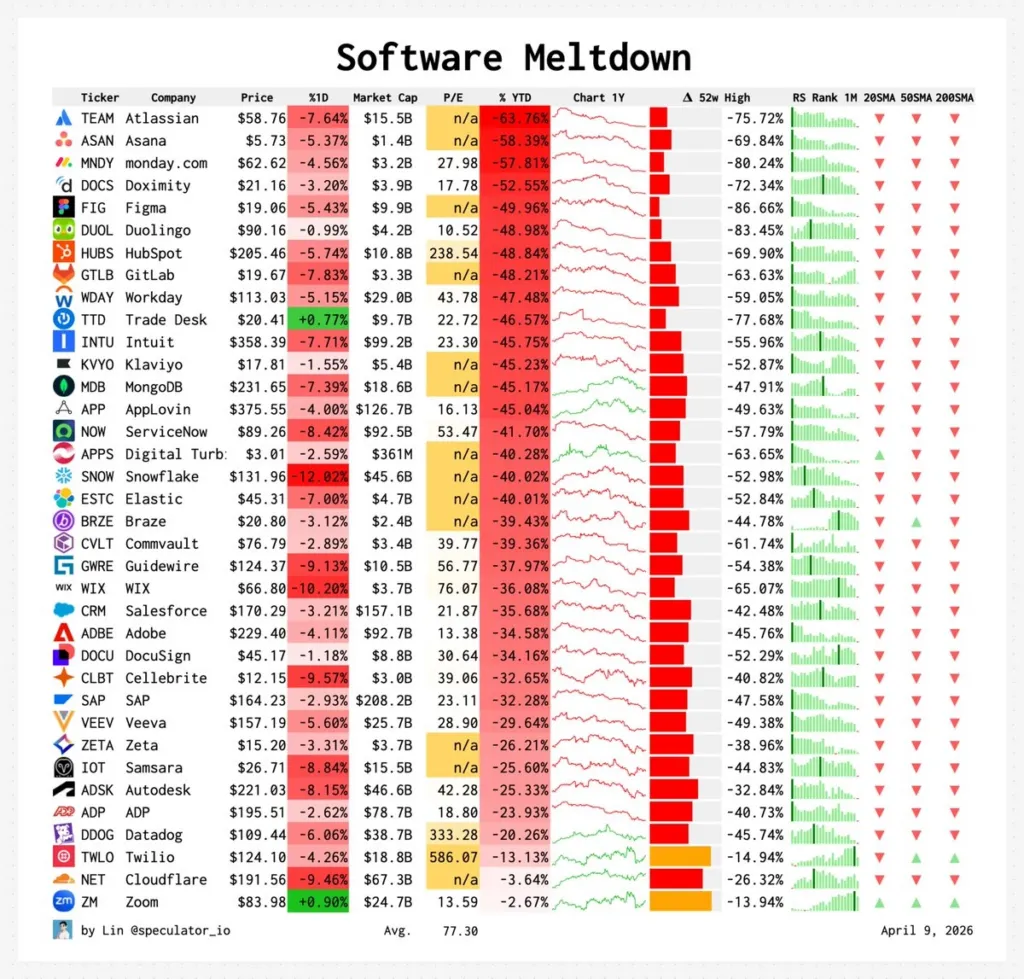
The software sector has lost roughly $2 trillion in market value in a very short span, and the iShares Expanded Tech Software ETF, IGV, is still down sharply from its September 2025 peak.
At the same time, software valuations have compressed hard. SaaStr says sector forward P/E dropped to about 22.7x in early 2026 from above 31x in late 2025, while Bessemer’s cloud index now sits around 5.9x revenue. That is not normal volatility. That is the market repricing a business model it no longer fully trusts.
The numbers are not just ugly. They are humiliating.
Some of the names being hit are not weak companies hiding in a bad corner of the market. They are category leaders.
HubSpot is trading far below where it stood a year ago. Figma, which came public at $33 and surged to more than $142, is now below its IPO price.
Asana, DocuSign, ServiceNow, and Monday.com have all taken painful hits from their highs. This is not one company getting punished. It is an entire sector being forced to defend its future at the same time.
That is what makes this moment feel different.
If the market were only worried about macro conditions, the damage would look more random.
Instead, the pattern looks structural.
Claude made the fear feel real
This is where it gets more unsettling.
A lot of people were still treating AI as a feature. A nice assistant. A productivity layer. Something that helps SaaS companies sell more software.
Then Claude started landing in places that made the threat feel personal.
Anthropic launched Claude Design, a product built to create prototypes, slides, one pagers, and quick visuals.
After that launch, Figma stock fell sharply, and Yahoo Finance explicitly tied the move to investor fears that Anthropic was targeting the AI web design market.
TechCrunch described Claude Design as a tool meant to help founders and product managers create visual work without a traditional design background.
That matters more than one stock move.
Because it signals something bigger.
The fear is no longer just that AI will help software.
The fear is that AI will sit above software, absorb more of the workflow, and make the individual tool feel less essential.
Figma feels that pressure in design. Asana feels it in work management. Canva, Slack, and other apps are now being pulled into Claude’s expanding ecosystem through MCP apps, letting Claude interact directly with tools instead of merely talking about them. In other words, the interface is starting to move upward.
The agent becomes the place where work happens, while the old SaaS tool risks becoming plumbing in the background.
That is terrifying if your entire pricing model depends on being the destination.
Retention is still strong. That is what makes this scarier.
The strange thing is that many SaaS businesses are not collapsing operationally.
Bain noted that gross retention across many software companies remains above 90%. Customers have not suddenly vanished. The software still works. The revenue is still there. But the market is no longer paying up for what those revenues used to mean.
That is the real message.
Wall Street is not saying software is dead.
It is saying the old reasons software deserved premium multiples are getting weaker.
And once the market starts questioning the future, it does not wait politely.
It reprices first.
The old moat was friction. AI hates friction.
For years, SaaS companies benefited from a simple truth: changing tools is annoying.
Migrating data is painful. Training teams takes time. Rebuilding workflows is expensive. That friction protected incumbents.
AI agents attack that protection directly.
A good agent can connect tools, automate workflows, summarize context, trigger actions, and reduce the number of tabs, seats, and clicks a company needs. If one intelligence layer can coordinate the work that once required several apps and several humans, then seat based pricing starts to look fragile. That is one reason JPMorgan says the drop in software valuations may reflect structurally lower terminal value because of AI disruption.
This is why horizontal SaaS looks especially exposed.
CRM. Project management. Design. Documentation. Collaboration. These are exactly the categories where the buyer may begin asking a brutal question:
Why am I paying for more seats if one agent can now do more of the work?
The next SaaS winner may not look like SaaS at all
This is the part many founders still resist.
The market may be moving away from software sold by seat and toward intelligence sold by completed work.
Not access.
Not licenses.
Not “How many people need this tool?”
But “How much output did this system create?”
That sounds like a small pricing change. It is not.
It changes product design, packaging, sales, and value capture. It also changes who survives.
General purpose software may have a harder time defending itself, while vertical software with deep industry context, proprietary workflows, and specialized data may hold up better.
Houlihan Lokey argues that vertical software is better positioned to capture AI value because of those deeper domain advantages.
A wiser way to read this moment
It is easy to read all of this and panic.
That would be understandable.
But panic is not vision.
The wiser read is this: software is not ending. Lazy software economics are.
The market is forcing a painful but necessary question. Not whether a tool is useful today, but whether it will still deserve premium value once intelligence becomes the main interface for work.
That is a harder question. It is also a healthier one.
Because the next generation of durable companies will probably not win by adding one more dashboard and one more seat.
They will win by owning judgment, workflow, and outcome in a world where the agent is slowly becoming the employee, the operator, and sometimes even the product.
That future will create new giants.
But it will also expose how many old giants were priced for a world that no longer exists.
I hope you enjoyed the story.
Subscribe | Buy a Coffee | Gumroad | Pro Bazaar | Amazon