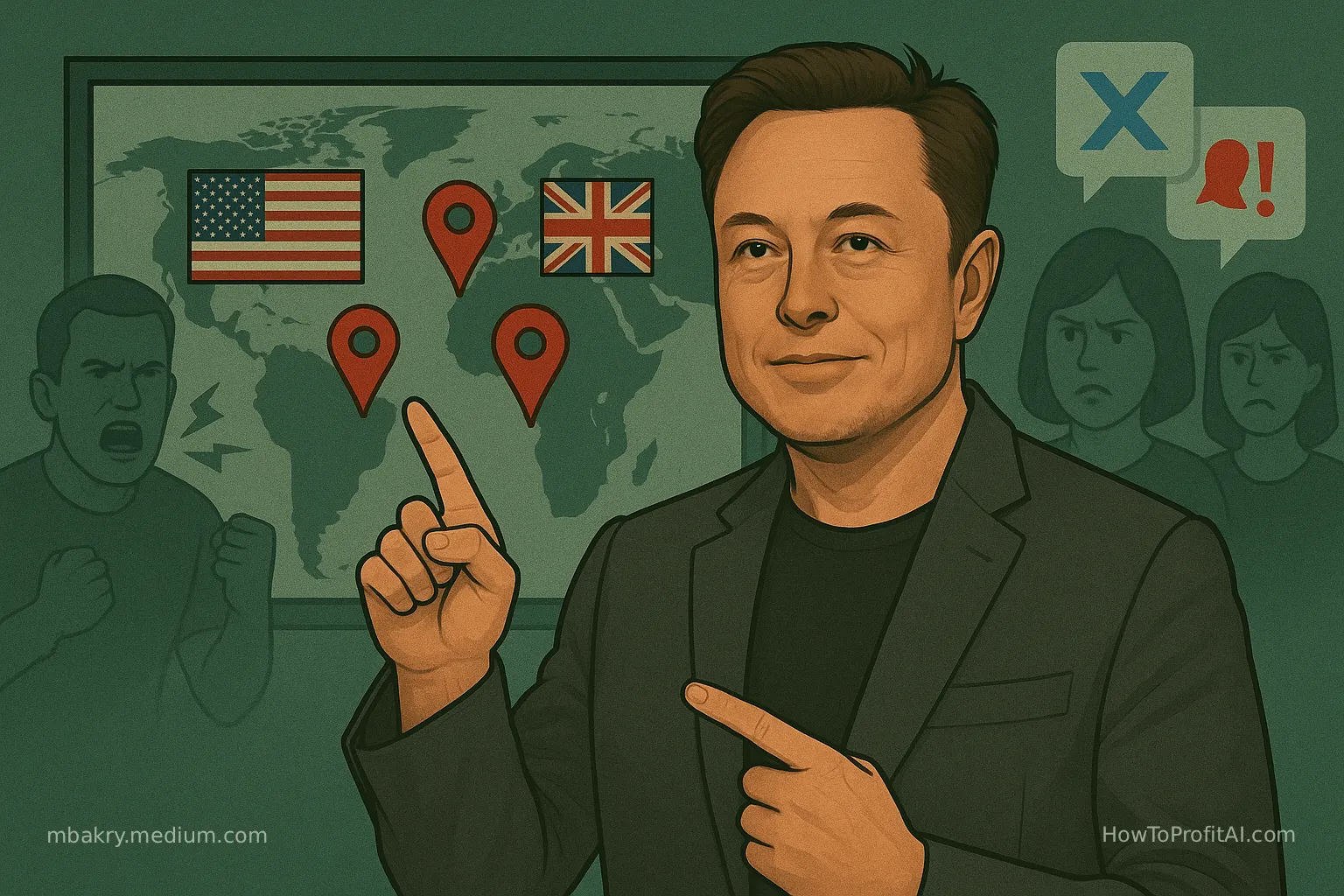
Their Real Locations Will Shock You
Don’t feed the flame all day and night… check the source before you join the fight.
You wake up, open X, and it starts as usual.
- An American “patriot” account telling you the other party is evil.
- A “French” profile mocking Muslims in Europe.
- An “Arab” account with a perfect local dialect, calling your country stupid and corrupt.
- A “Gaza witness” begging for donations from “inside the war zone.”
You feel it in your chest.
Anger. Shame. Defensiveness.
You start typing back.
Now imagine this:
A tiny update on X suddenly reveals where some of these accounts are really posting from.
And it turns out…
They’re not in your country.
They’re not even who they say they are.
Some of them may not be real people at all.
That just happened.
What X’s New Feature Actually Exposed
A week ago, X launched the “About this account” feature. It shows the approximate country or region linked to an account. This is based on technical signals, not just the country name in the user’s bio.
Within hours, users started noticing something weird:
- Some accounts pretended to be American, European, or Arab locals. But they were really posting from different countries.
- Pro-MAGA “US patriots” accounts were found to be bots or fake profiles. They operated in many regions.
- “Gaza influencer” accounts sharing dramatic war stories and asking for money were traced to Central Europe and other faraway countries, not Gaza.
In other words:
A feature designed for “transparency” briefly lit up a map of global manipulation.
Then the backlash started:
- Some users called it forced doxxing and worried about activists in dictatorships.
- X indicated VPNs could confuse locations, but also flagged suspected VPN users with a warning icon.

Not long after the uproar, the visibility of the feature was limited/changed. But for a short window, the curtain slipped.
And we saw something ugly.
The Shock: “Your” Hate Isn’t Always Coming From Your People
In the United States
In the U.S., users started checking political accounts:
- Profiles using ideal “American” slang stir up intense Republican and Democrat anger. These come from places like Russia, India, and Bangladesh.
- Culture-war accounts that seem to live 24/7 online.
Reports showed that some of these “local” accounts were in fact operating from Russia, India, Bangladesh, and many other countries
/media/8ca8e658e01aba7063ab9cb88c4edcc4Source: Harry Sisson’X Accoount
/media/1f9a5d42de06fd468c7f3744051429fbSource: Jimmy Midyette’X Accoount
But the new location glimpse turned the abstract idea of “foreign interference” into something very personal:
That angry “patriot” arguing with you…
may be sitting in an office on another continent, paid to make you hate your neighbor.
In Europe
Across Europe, something similar appeared:
- Accounts claiming to represent European nationalism and “Make Europe Great Again” movements were traced to South Asia, Vietnam, and Australia.
- Accounts pumping division between Muslims and non-Muslims, “native vs migrant,” left vs right…
- Some of them are clearly not located in the countries they claimed to represent.
At the same time, the EU is officially telling citizens to prepare 72 hours of food, water, medicine, and cash for a crisis war, blackouts, and cyberattacks.
So Europeans are being told:
- “Be ready in case the system blinks.”
while their timelines are being filled with rage-optimized content that quietly pushes them apart: French vs German, Pole vs migrant, left vs right.
In the Middle East
Middle East users started comparing notes:
- Profiles posing as “Gulf girls” were posting nonstop, pushing moral panic and sectarian fights, yet their accounts showed they were based in places like the UK.
- Other profiles claiming they were “from Gaza” spent more time attacking Arab countries than talking about Gaza itself, and some appeared to be operating from abroad.
So… who’s really behind the microphone?
And who benefits first when Arabs turn their anger away from Gaza and toward each other?
From that angle, one thing becomes obvious:
Not every “Arab vs Arab” hate wave is real. A lot of it is manufactured — and you’re being invited to help spread it.
Thousands of Arabic-language posts are designed to:
- Make them feel alone.
- Make them feel their country is uniquely rotten, so they get disappointed.
- Convince them that other Arab nations secretly despise you.
All while many of those accounts are posting from completely different countries… or even automated systems.
Feels like “Bots in Uniform.”
What Happened After the Leak
- X suspended a large number of accounts flagged as “inauthentic” after the data became visible, but many accounts still remain.
- The location feature was not disabled. It’s still live, but access is limited, and data is estimated, not real-time.
- Screenshots of the feature were shared widely, and people recognized that this hatred is not factual.
The lesson is clear: if one tiny feature can expose that much manufactured hate in under an hour, imagine what still lurks in the shadows, protected by people with real power.
The Hebrew Translation Scandal: When the Filter Breaks
Around the same period, another weird thing happened on X:
- Grok, X’s AI chatbot, told users that automatic translation of Hebrew content had been disabled because it often amplified violent, inflammatory posts.
- The claim went viral: “X turned off Hebrew translation because the content was too genocidal.”
So:
- On one hand, translation features can reveal what a language community is really saying.
- On the other hand, platforms can silence or distort that visibility, whether intentionally or by chaotic moderation.
The pattern is simple:
The tools that should connect us
can be tuned to divide us…
The Real Game: Turning You into Ammunition
Let’s step back.
Look at the pattern across the U.S., Europe, and the Middle East:
- Foreign-run or anonymous accounts pretending to be locals.
- AI-generated content and bot networks are pumping emotional posts 24/7.
- Platforms with weak, biased, or chaotic moderation.
- Governments and cyber units are openly developing AI systems to analyze and influence world communication at scale.
What’s the goal?
It’s not just “trolling.”
It’s shaping reality.
If you can:
- Make Americans believe half their country hates them,
- Make Europeans feel surrounded by enemies,
- Make Arabs believe other Arab nations secretly despise them,
And the most painful truth?
You don’t need “millions of bots.”
You just need enough fake consensus to make real people do the spreading for free.
You can’t fix X, or Meta, or the EU, or Washington.
But you can stop being the easiest target in the room.
Here are five practical rules to follow from now on.
1. Treat anonymous rage as possibly foreign, possibly fake
Next time, a “local” account:
- Insults your country,
- Mocks your religion,
- Tries to turn you against another nation or group,
Pause and assume:
“This might not even be from here.”
Check:
- Do they post 24/7 across time zones?
- Is their content only rage, never real life?
- Does their location or language feel… off?
If yes, don’t feed it. Don’t quote-tweet it. Don’t amplify it.
2. Stop letting screenshots set your blood pressure
Ask:
- “Do I know anyone like this in real life?”
- “Is this a real problem, or a screenshot designed to make me hate someone?”
If the only place you see that level of extremism is online, not in your street, mosque, church, or office, treat it as psychological warfare.
3. Follow people who show their work, not just their anger
Look for:
- Journalists sharing on-the-ground footage with sources.
- Analysts who link to reports, data, and documents.
- Creators who admit nuance not only fire.
Unfollow (or mute):
- Accounts that never admit uncertainty.
- People who always push you toward hate, never toward understanding.
- Profiles that only exist to “own” or humiliate others.
4. Don’t help them map you
Remember: every like, repost, and comment is data.
It tells someone:
- What triggers you.
- Which topics polarize you.
- Which identities you defend fastest.
That’s gold for anyone building a targeting model.
Be deliberate:
- You don’t have to react to everything.
- You don’t owe a reply to every provocation.
- You’re allowed to scroll past rage bait.
5. Re-anchor your reality in offline life
Talk to real people from “the other side”:
- Your neighbor who votes differently.
- The Syrian, Palestinian, American, or Polish colleague you actually know.
- The person in your mosque, church, or café who doesn’t sound like your timeline.
Most of the time, you’ll notice something:
People are more complicated — and less hateful — than the accounts shouting in your feed.
That’s your proof that much of the online “civil war” is manufactured.
My Vision:
You Are Not Crazy. The Game Is Rigged.
If you’ve felt lately that:
- Everyone hates everyone,
- Every group is screaming,
- Every country is on the edge,
You’re not imagining it.
This is just our current world where:
- Governments, cyber units, and private actors use platforms as weapons,
- AI and bots can speak in your dialect better than some of your cousins,
- And a “small feature” on X can briefly reveal how fake a lot of it actually is before the window closes again.
This isn’t about becoming paranoid.
It’s about refusing to be remote-controlled by anger.
The next time you feel your heart racing because of a post from “someone like you” or “someone who hates you,” remember:
It might not be a neighbor.
It might not be your countryman.
It might not even be human.
The Ones Teaching You to Hate Your Own People, Mostly Not from Your People
Act accordingly.
When the story feels airtight, ask one thing: who benefits from the fight?
Take care, please… spread the awareness.
FAQs
Q: How does X’s new location feature work?
X’s “About This Account” feature displays the estimated country or region where an account primarily operates, based on technical signals like IP address, device data, and activity patterns — not just what the user writes in their bio. You can access it by clicking on an account’s join date on their profile.
Q: How Do I Check an X Account’s Location Using the New Feature?
To see where an X account is actually based, follow these steps:
- Open the X app and go to the Search tab
- Type the account name you want to check
- Tap the account name from the search results
- Click where it shows when the account joined (the date)
- This opens “About This Account” page showing the country/region
The feature shows approximate location, not exact coordinates, based on IP address and technical signals.
Q: Can VPNs Hide My Real Location on X?
Partially. X can detect VPN usage and flags suspicious accounts with a VPN warning icon or exclamation mark next to their location.
Q: Which MAGA accounts were exposed as foreign-run?
X’s location feature revealed that several prominent pro-Trump accounts, including @MAGANationX and @TRUMP_ARMY, were actually operating from Thailand, Nigeria, Bangladesh, Eastern Europe, and other countries — not the United States. NBC News, CBS News, and Newsweek documented these findings before many accounts were suspended or the feature was limited.
More References: 1, 2, 3, 4, 5, 6, 7
I hope you enjoyed the story.